
Waterfall Illusion
by Kevin Adams on Jan 28, 2026
!
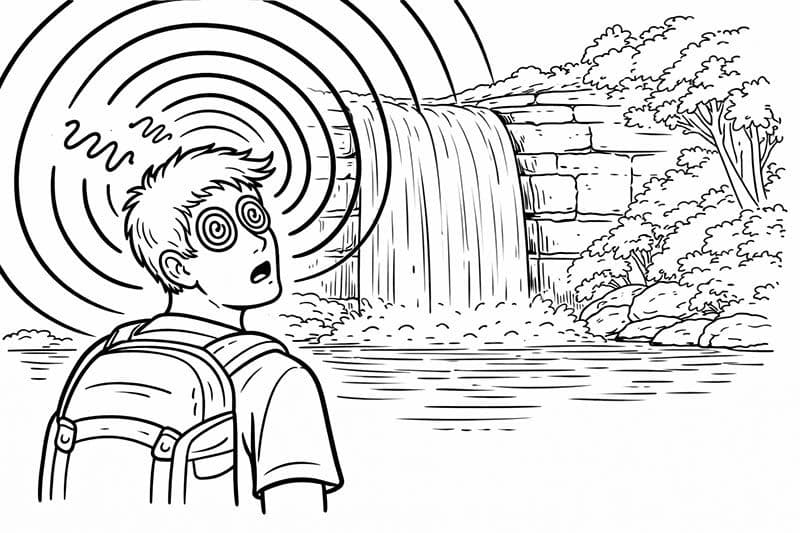
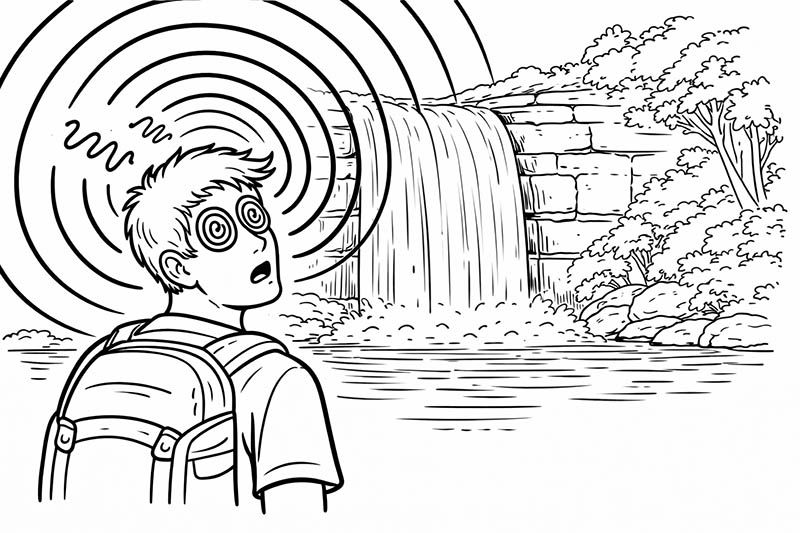
Here’s a fun thing to do on your next waterfall outing. You may have already noticed that if you stare at a waterfall for several seconds, then look at a stationary object beside the falls, the still object appears to move. This is the “waterfall illusion” or “waterfall effect,” also known as “motion after effect,” and it’s a real physiological experience.
What causes it? An explanation provided on the excellent website The Illusions Index states:
[W]hen you are watching the stimulus with motion (for example, the moving water in a waterfall), the neurons that detect continuous movement in one direction (e.g., downward) become less sensitive to motion at that speed in that direction. As a result, when you look away, neurons that detect movement in the opposite direction (e.g., upwards) are more active in comparison. This results in the appearance of the stationary object moving in the latter direction (upwards). It is thought that many properties that we experience are encoded in this way in the brain: by a comparison between the firing rates of different populations of neurons, rather than the particular rate of each.
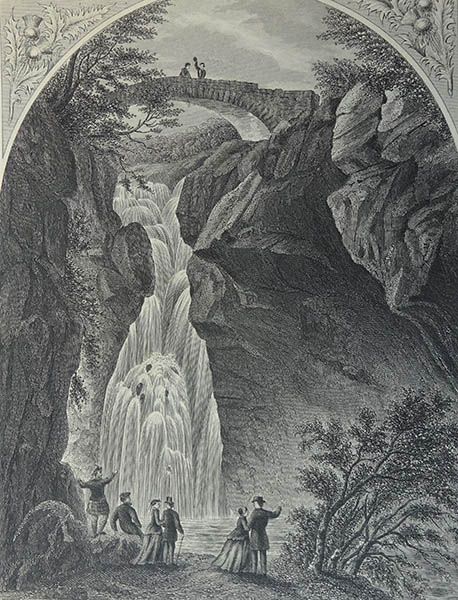
The Falls of Foyers. Engraving made circa 1860s -1870s. (M043)
The illusion was likely known to the earliest humans (Aristotle talked about it), but it was popularized in 1834 when Robert Addams wrote a report in The London and Edinburgh Philosophical Magazine and Journal of Science. Addams, who had witnessed this illusion at the famous Falls of Foyers in Scotland, wrote:
During a recent tour through the Highlands of Scotland, I visited the celebrated Falls of Foyers on the border of Loch Ness, and there noticed the following phenomenon.
Having steadfastly looked for a few seconds at a particular part of the cascade, admiring the confluence and decussation of the currents forming the liquid drapery of waters, and then suddenly directed my eyes to the left, to observe the vertical face of the sombre age-worn rocks immediately contiguous to the water-fall, I saw the rocky surface as if in motion upwards, and with an apparent velocity equal to that of the descending water, which the moment before had prepared my eyes to behold this singular deception.
You don’t have to look at a waterfall to experience the waterfall illusion. Just google waterfall illusion and you’ll find all kinds of graphics to watch that will trigger the effect. One of the best I’ve seen is the one shown below. Stare at this rascal for a little while and you’ll be astonished when you look away.
This is cool stuff for waterfall nerds like me!