
The Biggest, Baddest, Most Fantabulous Waterfall in the World
by Kevin Adams on Jan 20, 2026
!
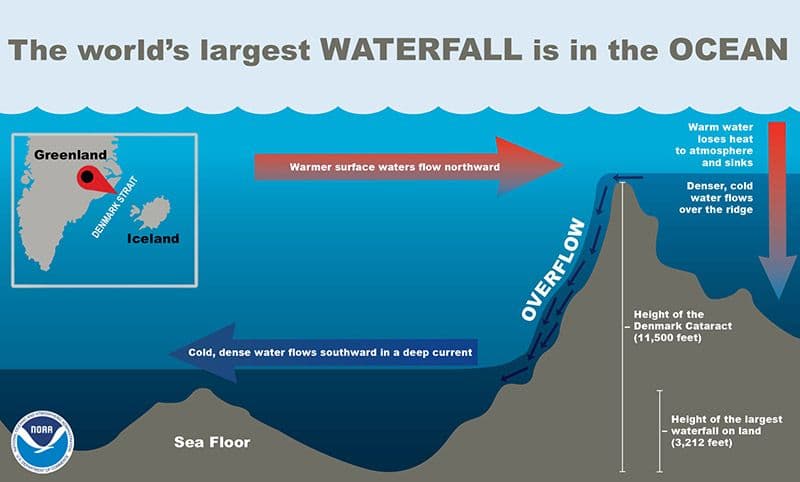
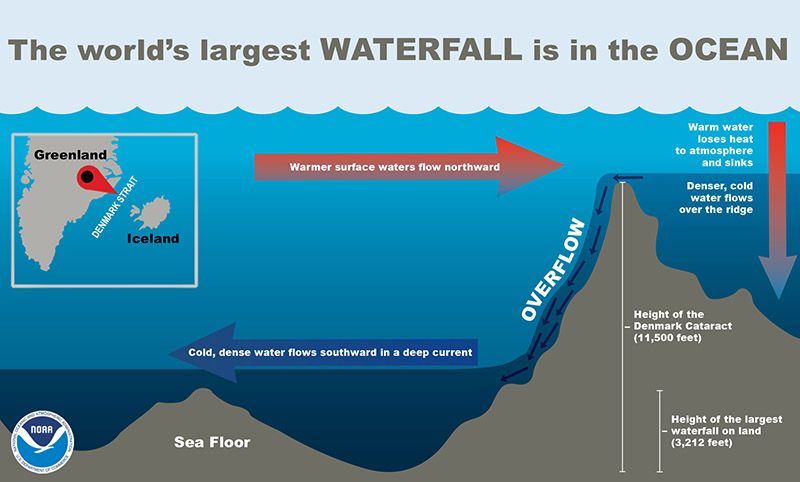
Infographic from NOAA’s National Ocean Service website.
The world’s tallest waterfalls are usually on rather small streams, while the widest ones are typically on large rivers. And those with the most water flow are always relatively short—hundreds of feet high, not thousands.
But there’s one waterfall that sits at the top of the list in all these categories and most others that you could think of: Denmark Strait Cataract. There’s just one teensy-weensy problem with this waterfall, though. You can’t hike to it without drowning. Denmark Strait Cataract is located exactly where its name implies: Denmark Strait, in the ocean. That’s right; the world’s largest waterfall is underwater!
How is this possible? First, let me assure you that this isn’t another one of my elaborate April Fools’ Day posts. I mean, today isn’t April Fools’ Day, so, there. An ocean waterfall—there are several of them—is possible “because cold water is denser than warm water, and in the Denmark Strait, southward-flowing frigid water from the Nordic Seas meets warmer water from the Irminger Sea. The cold, dense water quickly sinks below the warmer water and flows over the huge drop in the ocean floor, creating a downward flow…”
The amount and size of this downward flow is hard to comprehend. The overall height is roughly 6,600 feet, twice the height of Angel Falls. The width is a staggering 300 miles. And the volume of flow? Roughly 5 million cubic meters per second, thirty times higher than Niagara Falls. That’s even more astonishing when you consider that the flow rate, or how fast the water descends, is only about 5 feet per second compared to Niagara’s 100 feet per second. And the length of run? That would be well over 300 miles.
Impressive, yes, but if you digest these figures you’ll see that this isn’t really like a typical waterfall, irrespective of the thing about it being in the ocean. A 6,600-foot waterfall falling over a distance of 300 miles means the descent is only 22 feet per mile. That wouldn’t even be a respectable river rapid.
By the way, this was a toughie to research. I stuck with known and respected sources, but there were inconsistencies in the stated figures. For example, most sources state the height of the waterfall at around 11,500 feet, but according to one source, whose figures I quoted because they seemed to be the most accurate, the water descends for only about half that distance, while the other half remains more stationary.
See Citation 216 for the sources I used for this post.