
Hemlock Horror
!
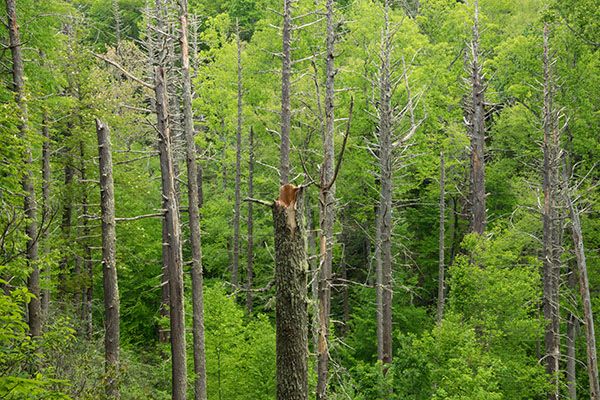
This was a typical scene for many years. Today, most of the dead hemlocks have fallen and are rotting away. The eyesore may no longer be there, but the impact from the loss of these trees will remain forever. (147389R)
Of all the negative changes regarding North Carolina waterfalls since I published the first edition of my North Carolinas Waterfalls book in 1994, the loss of our majestic eastern hemlock trees is among the most disheartening for me. If you want to see a grown man cry, come with me on a hike to any number of waterfalls that once harbored huge, old-growth hemlocks standing sentinel.
In 2002, a Great Smoky Mountains National Park trail worker noticed a white cottony substance on the underside of a hemlock branch. This was the first documented sighting of hemlock woolly adelgid (HWA) in the Smokies. First discovered in the East in the 1950s near Richmond, Virginia, HWA spread and in the late 1980s began attacking hemlocks in Shenandoah National Park. Today, nearly every mature hemlock across Virginia and North Carolina is dead.
Some efforts were made to combat HWA using a variety of measures such as sprayed foliar treatments, systemic insecticides, and released predator beetles. These efforts continue across the southern Appalachians on a limited basis, but it is far too late for most of the trees. No one anticipated just how quickly HWA would spread. As far as I know, the only mature trees living are the scattered few that have been treated.
I must admit feeling some resentment for how government and some private groups responded to the adelgid invasion in North Carolina. I understand that it happened so quickly that there was little to be done, but I feel like more research could have been done before the adelgid made it to the state. And as far as I’m concerned, once it did get here, we should have met it with overwhelming force instead of throwing in the towel and saying it’s too late and it would be a waste of money.
Okay, I’ll step down off my soapbox now.
The loss is incalculable from both an aesthetic and an ecological standpoint. Eastern hemlocks were among the most common, oldest, and largest trees in western North Carolina. Hemlocks were not valued as timber trees, so early loggers left many standing. Giant hemlocks could be found even in second- and third-growth forests. In addition, hundreds of acres of old-growth hemlock forests occurred in western North Carolina.
Hemlocks served an essential role in the ecosystem. With their large evergreen canopies, they shaded the forest floor, creating a microclimate that allowed certain organisms to thrive. Streams that are shaded by hemlocks have lower water temperatures, which is vital to trout and some invertebrate species. Hemlocks were also important for migrating birds. Some species of warblers nest almost exclusively in hemlocks. Researchers are studying these and other issues to understand the implications of the loss of the trees.
When the chestnut blight wiped out American chestnut trees, oaks and hickories assumed a dominant role in the forest. While they could not fully replace the chestnut’s role, they were able to mitigate it. Acorns and hickory nuts, rather than chestnuts, became the primary food for bears and some other animals. With hemlocks, it’s a different situation. No other trees can fill their ecological niche. Scientists don’t know exactly what is going to happen, but what is certain is that the forest ecosystem of the southern Appalachians is undergoing a change.
For waterfallers, the loss of hemlocks has other ramifications. Trees growing on steep banks beside waterfalls were usually left uncut since it would be too difficult to remove the logs, which weren’t prized anyway. As a result, many waterfalls had impressive hemlocks all around them, which added immensely to the aesthetic appeal.
Today, these grand trees are dead. Nearly all have already fallen. When they fall, they often land on the waterfall or in the pool. Although dead hemlocks decompose faster than many other trees, some of them are huge and will remain on the falls for decades. Of course, the trees are falling all over the place, not just at waterfalls. You’ll have to climb over, under, or around them on many of your waterfall hikes.
A few old hemlocks survive as result of treatments. If you see painted dots on the tree trunks, you’ve found a treated tree. I’m thankful for the trees that have been saved, but I must admit that it’s a bittersweet experience. It’s a stark reminder of what was lost.
HWA attacks juvenile trees as well as adults. I regularly see the cottony HWA on young hemlocks during my waterfall hikes. Perhaps one day scientists will discover a method to eradicate this pest, but the damage is done. Nothing will bring back the old-growth hemlock forests and the giant hemlocks that once graced our waterfalls.