
Homes, Hideouts, Shelters
!
Home is where the waterfall is. Kevin Adams
Numerous rock shelters exist in central and western North Carolina, some quite large. It’s likely that most of them have been used at one point in history for human shelter, if only to escape a thunderstorm.
A few well-known sites excepted, little archaeological research has been performed at rock shelters in the state. At some of the studied ones, scientists have uncovered human skeletons, animal bones, Indian artifacts, and other evidence of human use.
Humans have used rock shelters for a variety of reasons.
Shelter from inclement weather. Likely the most common use, and the only one still employed today on public property. I’ve ridden out more than one thunderstorm under a rock overhang.
Temporary living quarters. It’s logical to assume that rock shelters have served as temporary homes for families, hunting parties, or other groups.
Hideouts. Stories abound about outlaws, Indians, Tories, Civil War soldiers, and others hiding in caves and rock shelters in North Carolina.
Moonshining. What better place to operate a still?
Women’s seclusion shelters. In some native cultures, women secluded themselves from their communities during their menses and after giving birth.113
Ceremonial, healing, privation, spiritual. The authors of “Rock Features of Western North Carolina” suggest that some rock shelters in North Carolina may have been used for these purposes among Native Americans.113
Historical use of rock shelters at North Carolina waterfalls.
I’m intrigued by the geology and history of all rock shelters, but this site is about waterfalls, so I need to make a connection. Following is a list of shelters at or very near waterfalls, which of course is only a small fraction of the total number of rock shelters in North Carolina. Also, the list only includes those where historical use is known. There are dozens of other waterfalls with rock shelters that would be suitable for the uses described above, but for which I am aware of no such use.
Bird Rock Falls. A nice rock overhang occurs beside the trail to Bird Rock Falls, very near the falls. A stone wall and steps under the overhang clearly shows that someone used this site for something, but I can find no information about it. My guess is that it was for recreational purposes. Sadly, the site today is covered in graffiti.
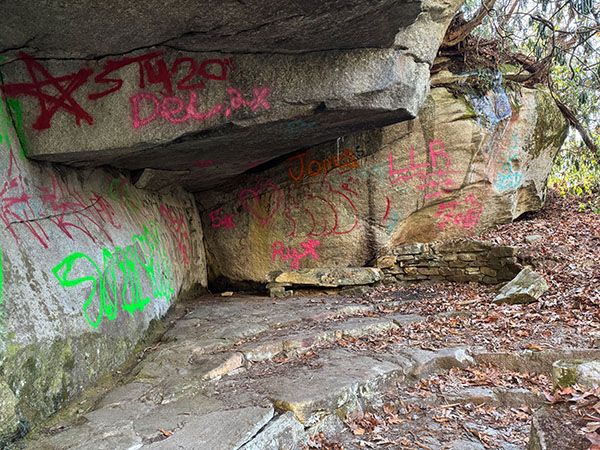
The rock shelter at Bird Rock Falls would be impressive if it wasn't ruined by criminals. (006B-258335))
Boren Mill Shoals. In The Land of Waterfalls by Jim Bob Tinsley, a photo of Boren Mill Shoals shows a still tucked under a rock overhang.108 A man is operating the still, and a rifle is leaning against the rock. I’ve always been intrigued by this photo, which is actually a setup shot using Tinsley’s father as the moonshiner. I can’t determine if there ever was ever a working still at the falls. (See Moonshine for more info.)
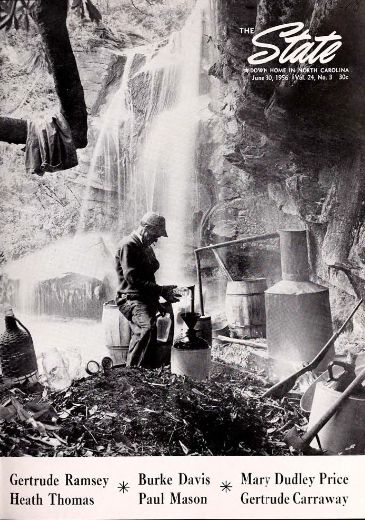
Arranged photo of moonshine still at Boren Mill Shoals. June 30, 1956 issue of The State magazine. Photo by Jim Bob Tinsley and Doug DePew. (098H-01)
Picklesimer Rock House Falls. In the early 1990s, a National Forest official told me this waterfall is named for a family of Picklesimers that once lived under the large overhang behind the falls. The story is repeated often, but I can’t find anything to support it. I do know that Picklesimer was a common name in the Highlands region. More recently, I read that Civil War soldiers used the falls as a hideout. I’ve found no corroborating information for this account, either.
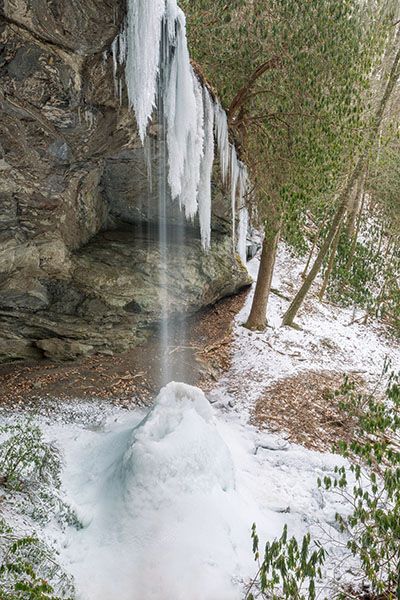
Picklesimer Rock House Falls. (059Z9-116593)
Still Falls. The evidence that this waterfall is the site of an old still is conclusive given that artifacts from the operation remain at the falls. Metal pieces, an old barrel, and glass shards are scattered about under the imposing cliffs beside the waterfall.
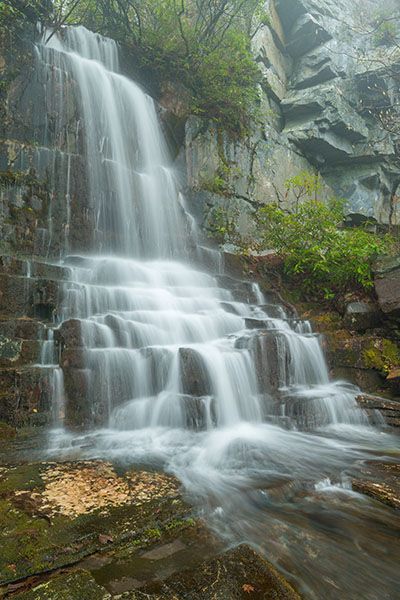
Still Falls (064Z3-117920)
Still House Falls. There are no artifacts at this waterfall, but there is a stacked stone wall that may have been part of the moonshining operation. Jim Bob Tinsley says in The Land of Waterfalls that “The last of many illicit stills underneath the falls was cut down just after World War II.” (See Moonshine for more info.)
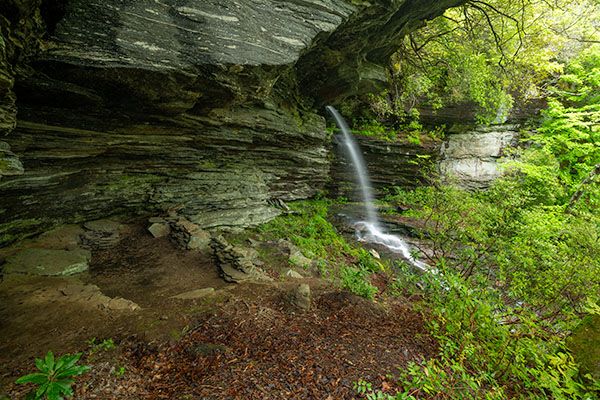
Still House Falls. (094A-213426)
Torys Falls. A short distance before reaching Torys Falls, the trail passes beside a deep hole in the cliff called Torys Den. The story goes that a group of Tories, having been forced from their homes by Whigs, hid in the grotto before being found and captured. If anyone has any info to corroborate this story, I’d love to see it. Everything I’ve found seems to be just a repeat of the legend.
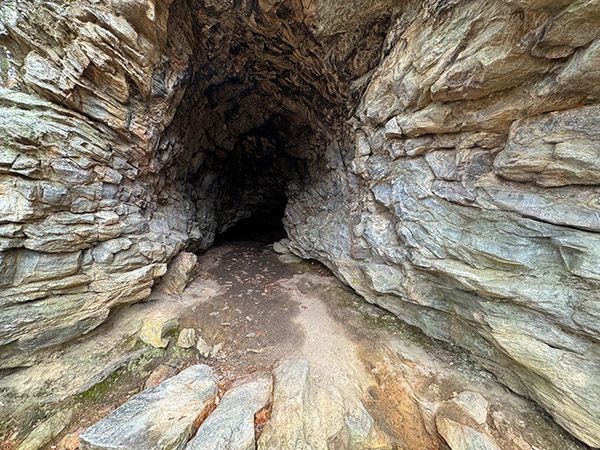
Torys Den. (60734)
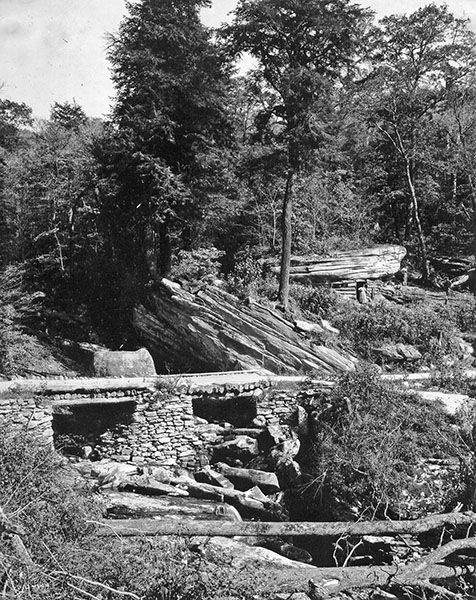
Waterfall 1 on Wilson Creek. Probably the most seen rock shelter in the state given is right beside a busy highway, this is the only one at a waterfall for which I have photographic evidence of it being used for shelter. George Masa photographed this view of the shelter along US 221 at Wilson Creek (then called Yonahlossee Road) sometime between 1915 and 1933.
Notice the woman standing in the doorway. Two men and boy are nearby. I’ve seen an account that says these people were galax hunters who lived under the rock while gathering the plant in the surrounding forest.
See the waterfall listing for more information about this rock shelter, including a Then & Now image pair.
Undisclosed Waterfall Cave. This one’s really cool! It’s not a cave, but the grotto does go back some 30 feet. It’s situated on a high perch above the waterfall, providing a great view of it. Colorful rock adds to the allure. I’d be surprised if this one doesn’t have historical relevance. The environment here is too sensitive to reveal the location.
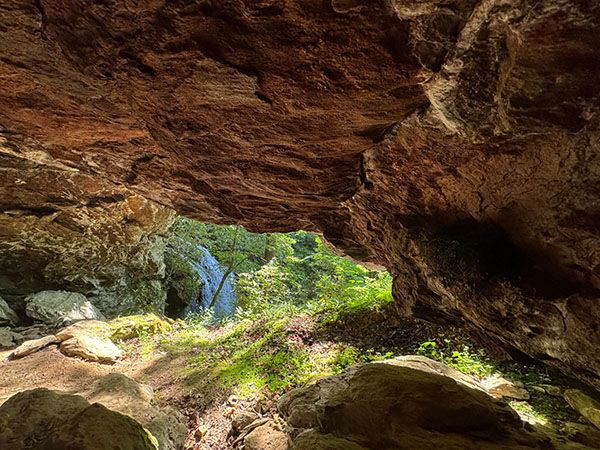
(2705250
Exploring rock shelters.
No doubt much remains to learn and discover at rock shelters across the state, including those at waterfalls. But while sleuthing around in a rock shelter sounds like a fun and exciting endeavor for waterfallers, it’s something that should be left to authorized researchers and archaeologists.
It is illegal to disturb historical sites on public lands or to remove historical artifacts, which includes relics from old stills, logging and mining operations, and old homeplaces.
Digging the ground under rock overhangs could also get you in trouble. The Archaeological Resources Protection Act (ARPA) of 1979 governs the excavation of archaeological sites on Federal and Indian lands in the United States, and the removal and disposition of archaeological collections from those sites.
Casey L. Kirby, MA, Assistant Forest Archaeologist for the National Forests in North Carolina says that “Rock shelter sites are some of our most looted sites, and our zone archaeologist has followed through with prosecuting ARPA cases against individuals that have looted rock shelters on the National Forest.”
This doesn’t mean you can’t explore and use your eyes. If you find a site that you think may have some historical significance, try not to disturb it in any manner. Take pictures, write notes, and send them to someone at the managing agency.