
Moonshine
!
Moonshining roots run deep in North Carolina. To some, Wilkes County is the “Moonshine Capitol of the World.” (Franklin County in Virginia has something to say about that.) Thousands of stills operated across the state, with the numbers exploding during the Prohibition era from 1920 to 1933.
Moonshine stills needed large quantities of fresh, clean water, so most of them were located along North Carolina’s streams. Given the large number of stills, it’s a safe bet that many of these operations occurred at waterfalls. In fact, some of the state’s waterfalls have names that reflect moonshining activity.
Relics from many old stills remain on site. If you spend much time hiking to the lesser known North Carolina waterfalls, there’s a good chance you’ll come across these artifacts. In Stone Mountain State Park alone, explorers have discovered the remains of over 200 stills.
I must have found artifacts dozens of times, but in only a few cases have I been able to definitively identify what I found as a former still. The logging industry also left behind a lot of artifacts, like steel barrels, which are among the most telltale signs of a still site. With that said, if you find old rusty barrels beside a stream, there’s a good chance you found a still site.
Keep in mind that in the national forests, state parks, and national parks, all historical artifacts, no matter how small or seemingly insignificant, are protected and it is illegal to remove or disturb them. Take pictures and leave the history intact.
I’ve no doubt that there are many more waterfalls to add to the list below, but these are the only ones I know for certain at this point. If you know of others, please let me know. Click the links to visit the waterfall’s detail page for more info.
North Carolina waterfalls associated with moonshine stills.
I don’t know if anyone operated at this waterfall, but if not, they missed a good chance. Right above the falls is a small bluff, with the perfect overhang for setting up a moonshine operation. Something happened here, evidenced by the stonework under the bluff, but I can’t find any info about it. My guess is that it was for recreational purposes, but it’s easy to imagine a still operating here.
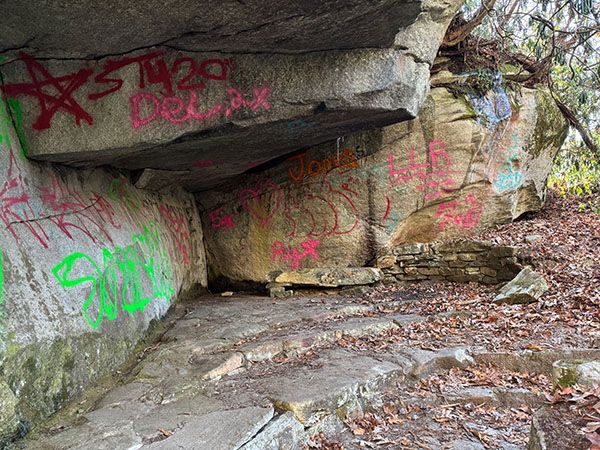
The "cave" at Bird Rock Falls. (006B-258335)
In The Land of Waterfalls, by Jim Bob Tinsley, there is a photo of Boren Mill Shoals showing a moonshine still beside the falls.108 However, it is unclear if a still ever operated at the waterfall. Tinsley states in the book’s preface that this is a posed photograph of his father “at a moonshine still on the Halfway Shelf of Boren Mill Shoals.” He doesn’t mention anything about whether the still itself is authentic, but photographer Doug DePew, who made the photo with Tinsley, states in the June 30, 1956 issue of The State magazine that he and Tinsley “lugged all the distilling equipment up the mountain for a shot to please ignorant flatlanders.” The photo appeared on the cover of that issue.
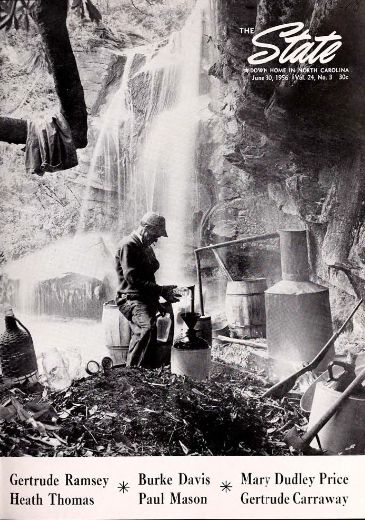
June 30, 1956 issue of The State magazine. Photo by Jim Bob Tinsley and Doug DePew. (098H-01)
The supreme example of a moonshiner’s dogged determination not to get caught by the revenuers, the still at Still Falls must have been a challenge to operate given its remote and rugged location. It’s hard enough to get there carrying a photo pack and tripod. I can’t imagine lugging big sacks of corn and gallons of moonshine.
This is the only waterfall I know of in North Carolina that has moonshining artifacts remaining on site. Old barrel remains and pieces from broken glass jars are lying around. Remember, it’s illegal to disturb these artifacts.
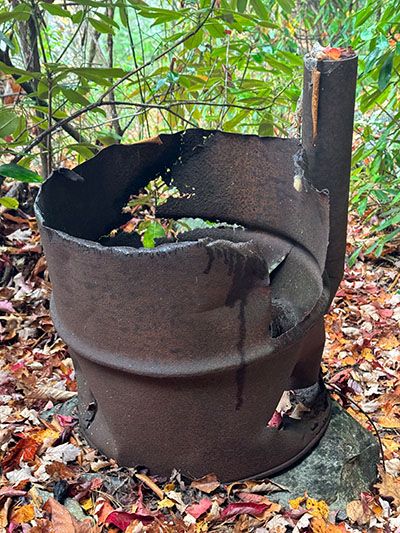
Artifact from old moonshine still at Still Falls. (064Z3-253138)
Here’s another waterfall for which I have no concrete knowledge of a still operating at the site, but given the name, one would assume so. I do know that a still once operated upstream from the falls, but far enough away that it seems unlikely to be associated with the waterfall’s name.
Here we have more than just the name to verify this waterfall as a still site. Jim Bob Tinsley writes in The Land of Waterfalls, that “The last of many illicit stills underneath the falls was cut down just after World War II.”109
Nothing remains of the stills, but a low, dry-stack rock wall might have been part of the operation. Tinsley states that one of the moonshiners built “a fence around his operation to keep ranging hogs out of his sour mash.” He didn’t say what the fence was made of, but it could have been rock.
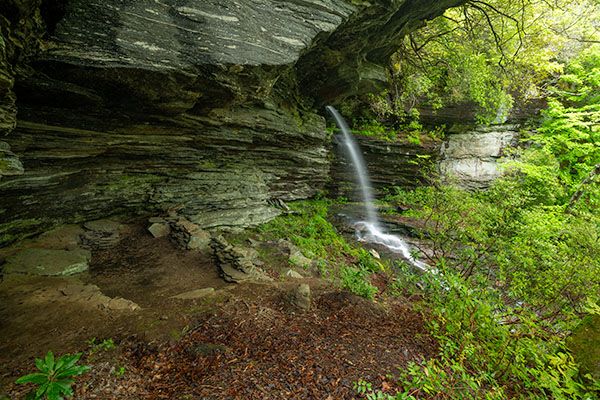
The rock overhang at Still House Falls creates a perfect location for a moonshine still. In this image you can see the flat area and rock wall where the stills were likely located. (094A-213426)