Biology
!
As long as I live, I'll hear waterfalls and birds and winds sing. John Muir
The scenic and sensory aspects of waterfalls are obvious and contribute much to the well-being of people who visit them, and the utilization of waterfalls for generating power has been widespread for hundreds of years. Less recognized are the benefits waterfalls provide for plants and animals. Let’s look at some of these associations.
Waterfalls, of course, occur on waterways. Waterways, of course, provide habitat and sustenance for countless species, and are critical for the survival of much of life on the planet. Here, I want to talk only about how waterfalls, independent of the stream they’re on, have a direct association for plants and animals.
Fauna
Very few animal species depend on North Carolina waterfalls for room or board, and most of those that do could live perfectly well outside the waterfall environment. Most of these species live at waterfalls because of the associated rock walls and overhangs. Some may take advantage of the plunge pools.
Salamanders
The moist rock crevices at waterfalls provide perfect habitat for several species of salamander. The green salamander, a North Carolina listed endangered species, lives on the cliffs at some waterfalls where the moisture level is not too high, but they are unlikely to inhabit the spray zone.
Birds
A few species of birds that nest or roost on rock cliffs are often found at waterfalls. I’ve seen many eastern phoebe nests at waterfalls. I would expect swallows to utilize the overhangs at some North Carolina waterfalls, although I’ve never witnessed it.
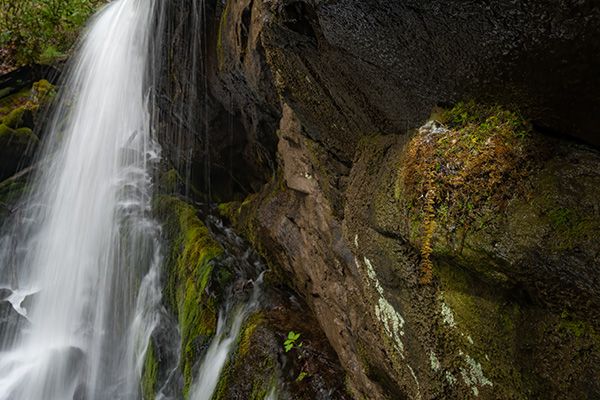
A bird's nest at Charleys Bridge Falls. I believe this is the nest of an eastern Phoebe. (028L-213250)
The great Kaieteur Falls in Guyana, often cited as the largest single-drop waterfall in the world, has a grotto behind the veil that is home to thousands of swallows that create a magnificent sunset show as they return to their roosts. In his 1887 classic, Great Waterfalls, Cataracts, and Geysers, John Gibson quotes a visitor who witnessed the spectacle. “I can only convey an idea of the multitude of these birds by saying that they were in myriads. Every now and then, as the flocks passed above the fall, thousands would swoop down almost perpendicularly with extraordinary velocity, and passing close over the edge, drop till opposite the great cave, then suddenly change their direction and shoot through the mist on either side into their roosting places.”95
Similar spectacles no doubt occur at other waterfalls around the world. In North Carolina, the closest comparison, though a very poor one, might be Bird Rock Falls on North Fork French Broad River. According to Jim Bob Tinsley in The Land of Waterfalls, the waterfall received its name because hundreds of purple martins once nested on the cliff beside the falls.96 I don’t know of any current nesting sites for purple martins at waterfalls.
Bats
I had always thought it likely that bats would roost in the deep grottos behind some waterfalls but did not see one until I was working on the third edition of my waterfall book in 2014. The waterfall is only about 15 feet high, but it has a deep recess behind the falls where I saw the bat on the ceiling. The ground below was covered in moss and had a rich growth of plants that appeared to have never met a footprint. I hope it never does and to that end I have not included the waterfall on this site.
Fish
The plunge pools at many waterfalls provide ideal habitat for fish and other species, but I’m not aware of any fish species that depend on waterfalls for living quarters. However, some waterfalls do have a relationship with certain fish species.
Waterfalls can prevent the upstream migration of fish and some other organisms. This allows certain species to thrive above the waterfalls, when they otherwise would have been annihilated by the migrating species. One example of this is the brook trout. Nonnative rainbow and brown trout, which are stocked, are more aggressive than the native brook trout, and on some streams where the rainbows and browns have been introduced, the brookies only exist upstream from waterfalls.
In The Land of Waterfalls, Jim Bob Tinsley says that Chub Line Falls on Toxaway River is the upstream limit of the chub minnow.111 There are waterfalls downstream from Chub Line that would seem to present insurmountable barriers to fish migration, but for sure if a fish made to Chub Line it would spend the rest of its life at the base of the falls.
Fishtop Falls on Green River is another North Carolina waterfall that may have been named because of being a fish barrier. In her book The Living Land, Marguerite Schumann calls the waterfall Fishstop Falls.98 That name makes sense, as it could refer to an upstream barrier for a certain species of fish, and considering that the waterfall is the final significant disturbance on the Green before it becomes a lazy river.
Spiders
Some species of lampshade spiders live on the rock overhangs at waterfalls are fairly common. Look for the distinctive webs shaped like—you guessed it—little lampshades.
Other Animals
In other parts of the world, waterfalls provide preferred habitat for other animal species. The torrent duck of South America, the American dipper of the western U.S., and the blue duck of New Zealand prefer fast-moving, choppy water, and often hang out at waterfalls. The rock-climbing catfish of Ecuador literally climbs waterfalls, as does the tiny waterfall climbing cave fish in Thailand. Brian J. Hudson talks about a species of frog that lives behind a waterfall in South America.99
Flora
There are far more plant species living at waterfalls than animals. But falling water does not create a unique environment for most of them and they grow just as easily outside the waterfall environment. However, there is one situation where the falling water does create an exclusive environment that harbors plants that do not grow elsewhere.
Spray Cliff Natural Community
“Spray Cliffs are communities of rock outcrops kept constantly wet by spray from falling water, sometimes supplemented by seepage. These communities are largely herbaceous but may contain some shrubs and trees. They are often small, sometimes vertical or nearly so, and may be partially shaded by trees rooted in adjacent forests.”101
The constant moisture from waterfall spray and the general sheltering from sun and wind create a relatively stable environment with a fairly constant year-round temperature. This provides habitat for plants that typically grow in warmer climates, especially bryophytes, which includes mosses and liverworts.
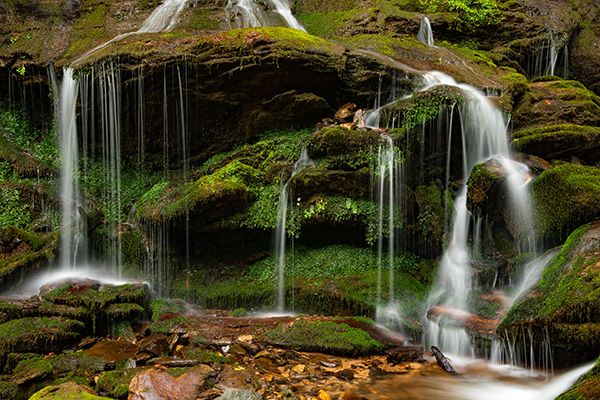
Spray cliff natural community at Turtle Rock Falls. (002Q-166873R)
Several plants that grow in this environment are extremely rare, with some known from only a few sites in the world. Most of the rarer plants are the bryophytes and are very small and difficult to identify. That mossy rock you’re about to step on could be home to one of the rarest plants in the world!
According to Classification of the Natural Communities of North Carolina. 4th Approximation, the spray cliff, as defined in the approximation, is a Southern Appalachian endemic community, occurring only in North Carolina, Tennessee, South Carolina, and Georgia.102 Waterfalls all over the world have spray zones where vegetation thrives, so I’m not sure what the distinction is. In tropical or cold climates, the spray likely doesn’t create the same kind of stable environment that is different from any other wet environment, but I don’t know why, for example, West Virginia can’t have a spray cliff community like we have. It’s on my list of questions for the next time I talk with a botanist.
The spray cliff community has a Global Conservation Status Rank of G2, which means it is imperiled and at high risk of extinction or elimination due to restricted range, few populations or occurrences (typically six to twenty), steep declines, severe threats, or other factors. However, this ranking was obviously assigned by someone who hasn’t spent much time waterfalling in North Carolina. There are hundreds of spray cliffs in the state! The slopes on the close quartet of Panthertail, Cold, Big Pisgah, and Shelton Pisgah mountains alone likely contain more than fifty spray cliffs.
Waterfall Keepers of North Carolina recently performed a botanical survey of one of the spray cliffs on these slopes and discovered several rare plant species. I would not be surprised if most of the spray cliffs on these mountains harbor unique plants.
A moderate amount of research has been performed on North Carolina spray cliffs, especially in the Lake Jocassee watershed region, but there is much work to be done. It would be terrific, and extremely beneficial, to have a thorough survey of spray cliffs throughout the state. While botanists will never be able to survey all the spray cliffs in the state, a representative sampling of spray cliffs in a watershed is possible given enough funding.