
Mining
!

As someone who loves to explore abandoned mines, I’m fascinated by the relationship with mining and North Carolina waterfalls. There are two ways in which mines have a direct connection to waterfalls. Some waterfalls did not exist until the mining operations, or they at least didn’t exist as they look today. The other influence is from mining operations occurring on or very near the waterfall, so the mining history is inextricably linked with the waterfall. Click the links for each waterfall to see more detailed information about the mining operations.
Waterfalls created by mining operations.
A surprising number of North Carolina waterfalls were created by explosions. A stream got in the way of blasting a hole in the ground and after the hole was created, the stream had no choice but to fall into it. Where practical, miners diverted waterways around the mining area, but this wasn’t always possible, and in the case of very small streams it didn’t hurt anything to just leave it alone.
Most of these kinds of waterfalls occur at big, open-pit mines that are still in operation, such as those in the Spruce Pine region. As you might imagine, all the operating mines are closed to the public, but there are a few mine waterfalls you can visit.
Bon Ami Falls. The premier mine waterfall that anyone can visit, Bon Ami Falls is located at Emerald Village, near Little Switzerland. The creek was diverted during mining operations, but then rerouted to be part of the tourist attraction. Emerald Village is a great place for the entire family.
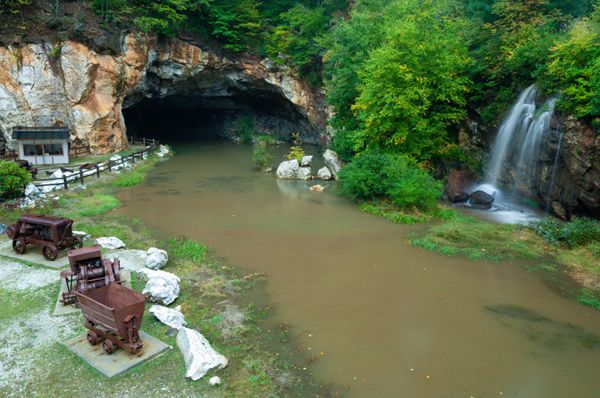
Bon Ami Falls and mine. (024F-24677)
Undisclosed Falls #1. This one is on public property, but I’m not disclosing its location for various reasons. A cool feature of this waterfall is that it not only was created by blasting, but the adit for the horizontal portion of the mine is located right beside the waterfall.
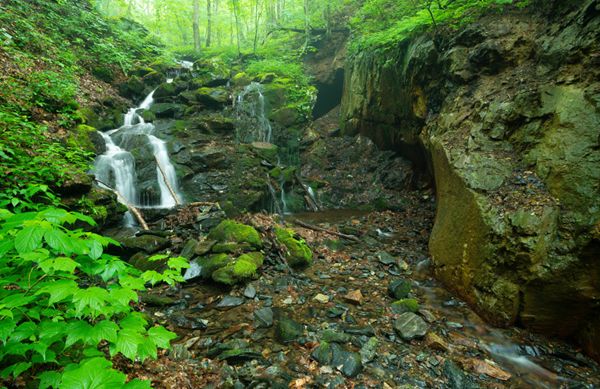
Undisclosed Falls #1. The mine adit is on the right, near the top of the falls. (007I-207184)
Uwharrie Falls. This fun little waterfall is located in Uwharrie National Forest. It consists of two separate drops, with the lower one dropping directly into Falls Reservoir. It’s evident that both drops were created by the mining operations, but I believe a waterfall of some kind existed here before the mine. It might have been more of a cascade.
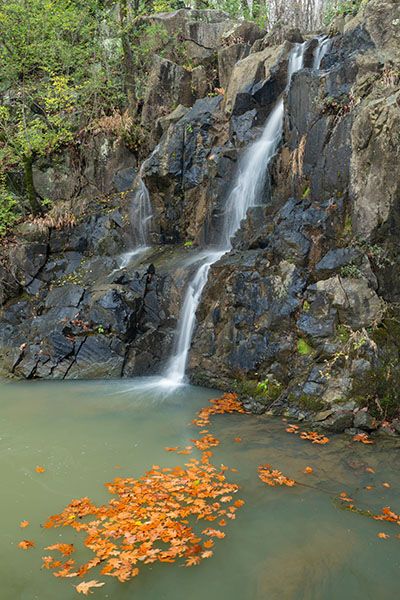
The lower section of Uwharrie Falls drops directly into Falls Reservoir. (100A-212160)
Mining operations affecting existing waterfalls.
These waterfalls existed before the miners came. The waterfalls were either altered slightly because of the mining, or they are just located very close to the mine. I suspect there are others in the state that would fall into this category, but there were so many small mining operations for which little or no information is available.
Glassmine Falls. As far as I know, this is the only natural North Carolina waterfall that has a mine in the waterfall itself. It’s fascinating that the horizontal shaft was blasted into the face of the falls. During normal flow, only a trickle of water drops over the adit, but at high water, the opening is hidden behind the falling water.
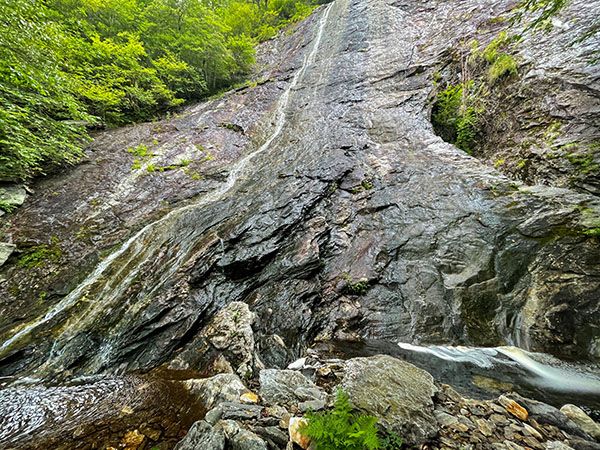
The adit for the old mica mine at Glassmine Falls is on the right. During a high- water event, the waterfall flows over the opening. (036A-207655)
Toms Creek Falls. The mica mine at Toms Creek Falls did not affect the waterfall itself, but rather the slopes below the falls. The mine is on the river-right side of the creek, just out of view from the falls viewing deck. On river left are the ruins of the cable and pulley system that transported the ore across the creek and dumped it into trucks.
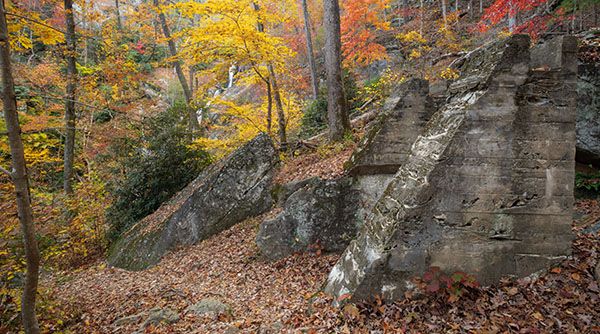
Concrete supports for the pulley system used to haul ore out of the mica mine at Toms Creek Falls. The waterfall is in the background. (111A-202741)
Quarry Falls. This is more a case of road construction affecting a waterfall, but the quarry across the road from the waterfall is how it got the name, so I’m including it here. Quarry Falls is beside US 64 in Nantahala National Forest.
Stone blasted from the quarry was used for constructing the highway. In the river at the base of the falls are large boulders that have drill marks in them. It’s hard to imagine them flying through the air during blasting, but they obviously aren’t there naturally. The historical photo makes it easier to understand. The entire area around the falls looks like a mining operation!
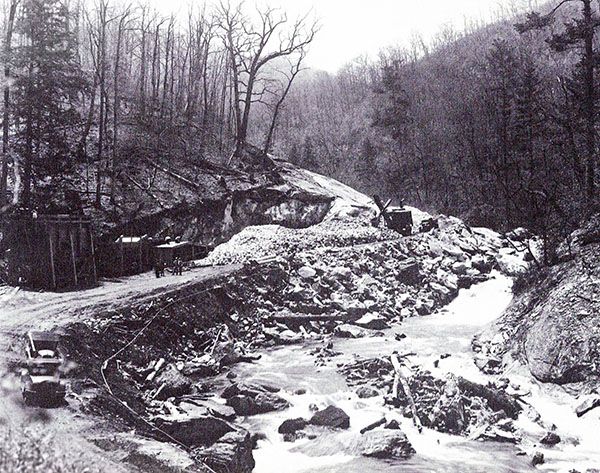
Quarry Falls during construction of NC 28/US 64, ca. 1929. (025E-01)